AI can create language.
Editors protect meaning.
Copy editing and proofreading for museums, cultural institutions and heritage organisations.
Strong editing preserves the original voice while improving clarity, flow, consistency and readability. The best editing often becomes invisible.
We can help you communicate with precision, shaping understanding and preserving knowledge.
Museums and public institutions operate in environments where language carries weight. A single inconsistency, ambiguity or tonal misstep can weaken credibility, confuse audiences or dilute the impact of important work. Increasingly, organisations are producing larger amounts of content across more channels, often under tighter deadlines. AI tools can accelerate the writing process, but speed alone can’t guarantee accuracy, sensitivity or coherence.
That is where professional editing becomes essential.
An experienced editor does more than correct grammar. They preserve intent, sharpen clarity, protect an institution’s voice and ensure content is ready for public scrutiny.
In an age of AI-generated content, the value of careful editing has never been greater.
We are copy editors for museums, libraries, research institutions and heritage organisations. Exhibition text, catalogues, scientific communication, web and donor-facing copy — read carefully, edited to publish.
What We Do
Exhibition and gallery text
Wall panels, object labels, introductory texts, educational resources, signage, audio scripts. Edited for clarity, tone, and house style; sense-checked and aligned with the curatorial vision.
Public-facing copy
Web pages, press, fundraising, membership and donor materials. Tonal range from accessible to authoritative without losing the institution’s character.
Our clients include;
The Victoria and Albert Museum · The British Library
The Francis Crick Institute · Bow Street Museum of Crime & Justice
Selected Projects
Editing services for cultural, heritage and research institutions
Here’s a selection of projects showcasing the range of work we have undertaken with our clients, spanning a range of subjects and styles:
The Francis Crick Institute
Ancient DNA exhibition, 2026. A deep-dive proofread of scientific content for a public exhibition for non-specialist audiences, in collaboration with the team at the Ancient Genomics lab.
Bromley Central Library
Museum collection showcasing the London Borough of Bromley’s rich heritage, 2026. Proofreading with a focus on consistency and style prior to production.
The Victoria and Albert Museum
Educational resources, 2024. Copy edit and proofread of a collection of educational resource material, working to V&A interpretation guidance.
The British Library
Medieval Women: In Their Own Words, 2024. A combination of copy editing and proofreading on circa 20,000 words for an exhibition exploring lives through manuscripts, documents and artefacts.
A Silk Road Oasis: Life in Ancient Dunhuang, 2024. Editorial support for an exhibition showcasing over 50 manuscripts, printed documents and pictorial works.
The Kerrison Trust
Website, 2022. Charity helping young, disadvantaged people in Norfolk and Suffolk.
Copywriting and editing, involving research into the organisation’s 150-year history and recent case studies.
Bow Street Museum of Crime & Justice
Permanent museum display, 2020. Editorial support comprising copy editing/proofreading on circa 10,000 words across permanent gallery text for the museum’s opening in London’s Covent Garden. Particular attention paid to fact-checking and historical accuracies, working closely with the museum’s curator.
Richmond Arts Service
Richmond First World War Stories, 2019. Copy editing and proofreading for an illustrated print and online heritage publication produced in collaboration with Orleans House Gallery.
Editorial Services
Most projects fall into one of four kinds of work. The level of edit – developmental, line, copy, or proofread – is agreed at the start once a sample of the text has been supplied and quoted accordingly.
Developmental edit – structure, argument, what the piece is trying to achieve.
Line edit – sentence by sentence, for rhythm, register (level of formality or technicality), sense.
Copy edit – grammar, punctuation, consistency, style sheet, fact-checking flagged at the margin.
Proofread – final checks on typeset pages. Marking-up PDFs.
Most projects use two of the four. Each is priced separately.
Exhibition and Interpretation Editing
Clear, accessible and audience-aware editing for:
- Exhibition panels
- Gallery interpretation
- Object labels
- Visitor guides
- Audio guide scripts
- Educational resources
- Interactive content
- Exhibition catalogues.
Complex ideas should feel engaging, not intimidating. Interpretation should remain accurate while still feeling human and accessible. We work from curator drafts to house style, with attention to word counts, reading order, and the visitor’s eye-line. Art, science, social history and library contexts are all areas in which we have experience.
Institutional Communications
Professional editing for digital, donor and institutional copy such as:
- Web pages
- Blog posts
- Journals
- Press releases
- Fundraising appeals
- Membership and trustee materials.
Tonally consistent with the institution’s published voice. Every institutional communication reflects reputation. Careful editing ensures consistency, confidence and authority across every channel.
Our Approach
Understand the audience
Every institution speaks to multiple audiences at once: academics, donors, researchers, press, educators and the general public. Editing begins by understanding who the content is for and how it needs to perform.
Where a house style sheet exists, we follow it.
Edit, don’t rewrite
The curator’s voice – or the scientist’s, or the historian’s – is the point. Our job is to make it cleaner and more fully itself, not to replace it. Any major concerns are raised as queries, not actioned silently.
Refine with precision
Every sentence is forensically checked for:
- Clarity
- Tone
- Accuracy
- Structure
- Consistency
- Grammar and punctuation
- Readability
- Institutional credibility.
The result is polished communication that still feels authentic.
Tracked changes and queries
All edits can be supplied as tracked changes with marginal queries (a clean copy is supplied on request). Authors retain control of every change.
Confidentiality
Unpublished material, embargoed exhibitions, pre-print research and donor correspondence are handled sensitively and accordingly.
Turnaround
We are realistic from the outset. A clear schedule is agreed before work begins; should deadlines need extending, we flag this early, not on the day.
About Us
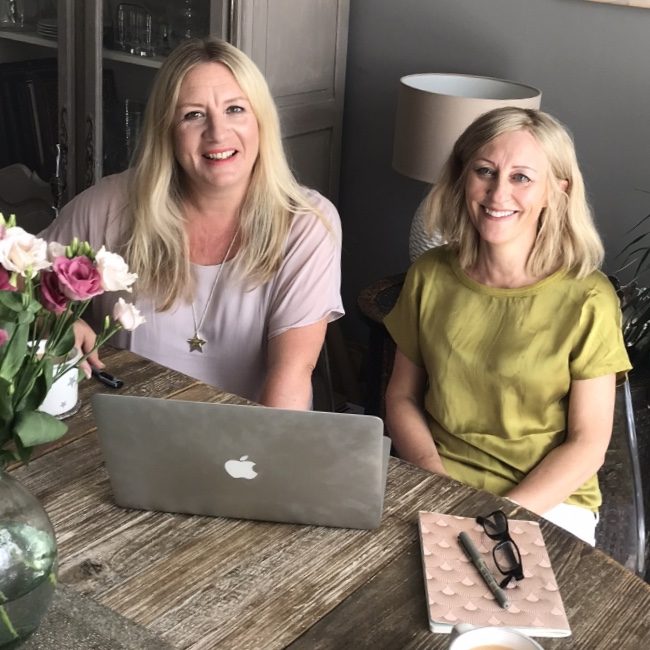
Christina Haindl and Mary Bennett, copy editors based in southwest London.
With extensive experience as writers, sub-editors, production managers and features editors across diverse consumer and trade publications, digital media and manuscripts, we know how to handle complex or technical subject matter, ensuring it’s engaging and accessible. Our grounding in these roles instilled in us the importance of thorough research and fact-checking with verifiable sources. We were trained to dig deeper, questioning every line for sense and authenticity, scrutinising picture captions and graphics to ensure compatibility with the text. After all, just one case of poor communication can quickly spread misinformation.
Our freelance work evolved into supporting small businesses and charities, helping them develop content for websites and wider communications. Researching Discover Your High Street, a Heritage Lottery Fund-supported project exploring seven outer London high streets, cemented our interest in cultural heritage. It showed us how much can be uncovered by digging into local stories and connecting them to a bigger picture – a fascination that led to projects including the illustrated publication Richmond’s First World War, unearthing little-known stories that rarely make it into history books.
We’re particularly interested in helping bring these stories to life for non-expert audiences: keeping them well researched, while making them accessible, engaging and relatable. Observing material as generalists means we ask the questions others might overlook. This deep-dive approach, rooted in years of methodical training in print media, has given us transferable skills and earned us a reputation for reliability, enthusiasm and a can-do approach – one recognised by the London Interpretation Network.
Verifiable sources and careful fact-checking are more important now than ever. At a time when AI can generate convincing copy without necessarily understanding context, nuance or accuracy, the human ability to question, investigate and make sense of information matters. So, who will you trust with your words?
Contact Us
Mary Bennett 07909 915095
Christina Haindl 07765 554705
Response time - usually within two working days.